01
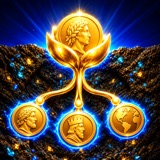
Choose your first coin
It will travel with you between the lenses. You can put it down at any time.
Tap a coin to pick it up.
 AUREVIA
An atlas of money through time
Follow 45 real currencies across five thousand years, from silver weighed in Mesopotamia to the euro. See where they were struck, trace their family tree and drag through the centuries.
How it works
Pick up a coin and carry it between them. The map, the dossier, the family tree and the timeline all follow you.
It will travel with you between the lenses. You can put it down at any time.
Tap a coin to pick it up.
Pick a region and a period. The coins that were in use appear where they were issued.
Open any currency's dossier: who issued it, how it looked, its story, its reforms and its sources. Tap the coin to turn it over.
See every reform, split and union as a living tree. Tap a coin to light its whole line.
Drag through five thousand years. The map, the coins and the other lenses follow the year.
Why Aurevia
From silver weighed in Mesopotamia to the euro, across eight regions: from the Mediterranean and East Asia to the Americas.
Replacements, reforms, splits, unions, continuations, models and names. Every link is dated and explained.
Coins and notes are engraved from each card: form, metal, inscriptions and signs, simplified into emblems. Turn any coin over.
Dates and reforms follow standard reference works, and every currency lists what it relies on, so you can read further.
No account, no sign-in, no analytics, no ads, no tracking. What you explore is saved in one file on your device and never leaves it.
Track the currencies you explore, the lineages you trace and the eras you visit. Choose any coin of the atlas as your avatar.
Showcase
Money in Aurevia is a family. Follow a coin back to the silver its ancestors were weighed in, one documented link at a time.
Before coins, money was silver weighed on a balance.
Stamped coins took over the job of silver weighed out at every deal.
Among the first coins ever struck.
Coinage spread from Lydia to the Greek cities of Ionia and then to mainland Greece.
The owl of Athens, trusted from Sicily to Persia.
Rome's first silver coins followed Greek models before the denarius.
Rome's silver workhorse for nearly five centuries.
The Frankish denier took its Latin name, denarius, from the Roman coin.
Twelve pence to the shilling, twenty shillings to the pound.
English silver pennies followed the Frankish denier, and 240 of them made a pound.
The oldest currency still in use.
The timeline
Drag the year and every lens follows. Each era keeps its own colour, from violet weighed silver to azure floating money.
Before coins, silver changed hands by weight.
Stamped metal appears in Lydia, Greece, India and China.
Rome and Han China run money across whole continents.
Dinars, deniers, florins and the first paper notes.
Thalers and pieces of eight circle the globe.
Decimal systems, new nations and the gold standard.
Hyperinflation, splits and a dollar tied to gold.
Free exchange rates, unions and new national currencies.
The cabinet
Coins and notes are drawn by the app, not photographed. Ancient and medieval dates are often approximate and marked with c.
Contact
A date that needs a source, a currency you would like to see in the atlas, or a bug to report. Every message is read.
ditaderyk@gmail.comA pocket museum of money
Five thousand years of money, from the first stamped electrum to the euro, all in your pocket and all offline.
Free · iPhone & iPad · iOS 16 or later